Cleared
How Assam demolished the homes of 20,000 families
23 September 2021
The eviction machine
One person displaced every 25 minutes, 24 hours a day, for nearly five years. The vast majority of those evicted are Bengali-speaking Muslims – a campaign driven by Assam’s Chief Minister Himanta Biswa Sarma, who is seen as a poster child for implementing the agenda of Indian Prime Minister Narendra Modi’s Hindu majoritarian Bharatiya Janata Party (BJP).
Maiful*, 65, says her family received an eviction notice in November and were given a month to respond. Before dawn, just a day after the deadline, bulldozers arrived.
“At five in the morning, while we were sleeping, three JCBs came and started demolishing our house.”


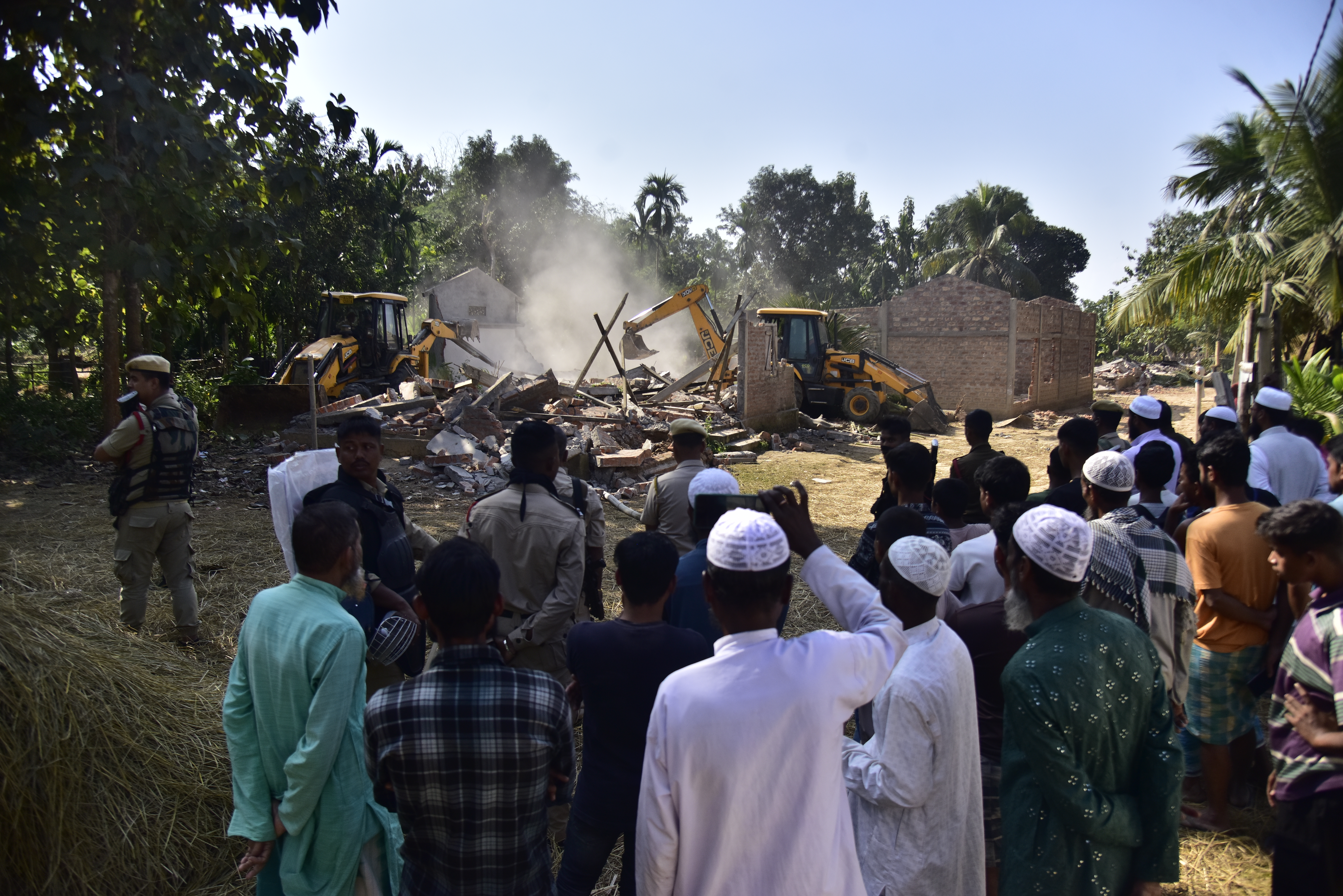
Villagers watch the demolition of their houses by local authorities during an eviction drive at an alleged illegal residential settlement inside a reserved forest area in Assam’s Nagaon district, on 29 November 2025.
A campaign of displacement
The Miya
Many of those now facing eviction are Miya Muslims, Bengali-speaking Muslims whose ancestors migrated from the Bengal region – parts of which now lie in Bangladesh – to Assam during the colonial period and settled on low-lying river islands called chars. These were marginal, flood-prone strips of land that nobody else wanted. Their forefathers had little choice.
Many settled there 50 to 60 years ago after losing their original homes and farmland to the Brahmaputra’s relentless erosion. Over generations, they cleared the land, farmed it, and built communities on it.
The word “Miya” was once a term of respect. Today, it is used as a slur to mark Bengali-speaking Muslims as outsiders, regardless of how long they have lived in Assam or whether they hold legal citizenship documents.
Cleared for development
But since 2016, these communities have faced a different kind of uprooting: government-led eviction drives targeting what officials call “illegal encroachments”. It is a label with consequences. In Myanmar, the same logic was applied to Rohingya Muslims for decades, branding an entire community as illegal immigrants on land they had lived on for generations.
The Assam government frames these evictions as action against “illegal immigrants” from Bangladesh. But the story is more complicated. Many of those being displaced are Bengali-speaking Muslims whose families arrived after 1947, when
Some came with official permission from the government of what is now India. Others were given land by the Indian state itself, often unproductive char lands that the government was eager to have cultivated. By the time the evictions began, many had been living in Assam for 50 to 70 years.

Gorakhor Unarni
Olamghuri Village, Nagaon District
Translation“15 days to vacate. No compensation will be entertained.”
After partition
More than one third of Assam’s 31 million people are Muslim – one of the highest proportions of any Indian state. That demographic reality has made Assam a focal point of a broader national shift. In recent years, Modi’s BJP-led government has faced repeated accusations of enacting laws and policies that specifically target India’s 200 million Muslims, from the Citizenship Amendment Act, which critics say deliberately excludes Muslims from a fast-tracked citizenship pathway, to the National Register of Citizens, which left millions stateless. In Assam, these national policies have found their sharpest expression.
What makes these evictions particularly troubling is that many families held Patta – official land titles issued by the Assam government – along with ration cards and voter IDs, documents that under Indian law establish legal residence and citizenship.
Some Pattas dated back decades, proof that the state itself had recognised their right to the land. Yet documented cases show Patta-holders being evicted without warning, without due process, their legal papers rendered meaningless overnight.
The register
The National Register of Citizens (NRC) – initiated after the right-wing BJP came to power in 2016 and concluded in 2019 – was designed to identify who qualified as an Indian citizen in Assam. To be included, residents had to prove that they or their families arrived in Assam before 24 March 1971 – the eve of Bangladesh’s independence from Pakistan. The final list excluded nearly two million people (roughly 6% of Assam’s population) who failed to meet this requirement. Many were poor. Most were Muslim. For many observers, the NRC was not an administrative exercise. It was the latest manifestation of a broader, systematic effort by the BJP government to target and disenfranchise India’s Muslims, using the machinery of the state to question the citizenship of communities that have lived on Indian soil for generations.
The process was not free from error or bias. Legitimate citizens were excluded on the basis of technical errors, spelling mistakes, and documentation challenges. Several detention centres were established, including India’s largest dedicated detention centre opened in Goalpara and designed to house up to 3,500 people. In some cases, children were separated from their parents. For many of the evicted, there is literally nowhere legal to go.
Zain*
“My father and grandfather lived here. We came from another part of the state to Uriamghat because the government told us to settle here to protect the land of Assam.”
“This has been going on for 80 or 90 years. We grew up in poverty and built our houses with hard labour.”
The has triggered repeated bouts of violent clashes over the decades. Two major confrontations in 1979 and 1985 left more than 100 people dead. In the 1970s, the Assam government settled landless communities in this zone as part of a strategy to strengthen its territorial claims. According to Zain, his family was part of that policy. Now, decades later, the same government is demolishing the settlement it once built.
The families of those civilians are now being labelled as “foreigners”.
“Bulldozer justice”
“Our village is 70-75 years old. It was not a forest land; it was Pattaland. We showed our documents to the district officer, but they were rejected. It was written in the papers that this land is ‘not indigenous’ and reserved for public development.”
“Nearly 60 bulldozers came early morning around 6am and bulldozed our village, including our houses.”
In India, the yellow JCB has taken on a meaning far beyond its function as a machine. Since 2017, the brand name has become almost generic in the country – used interchangeably with “bulldozer”, especially during state-led demolition drives that critics say bypass due process. Amnesty International verified at least 33 instances of JCB equipment being used in what it described as punitive demolitions of Muslim properties across five states.
The practice has acquired its own name: “bulldozer justice”, a term used for demolitions that are openly celebrated by BJP leaders and their supporters. Amnesty International had described JCB as the “brand of choice in a hate campaign against the minority community”. Over time, the yellow excavator itself has become a potent political symbol for the use of demolitions as a show of state power against marginalised communities.
“The brand of choice in a hate campaign against the minority community.”
Amnesty International, February 2024Rights groups and legal scholars often draw parallels between India’s “bulldozer justice” and Israel’s long-standing practice of demolishing Palestinian homes in the occupied territories. Since 1948, Israel has used home demolitions as a central tool of displacement against Palestinians, demolishing more than 55,000 homes since 1967 alone. The justification is almost always the same: illegal construction, encroachment, or a bureaucratic infraction.
The language driving these evictions in Assam has been sharply polarising. Chief Minister Himanta Biswa Sarma has a long record of Islamophobic rhetoric, frequently framing Bengali-speaking Muslims as “Bangladeshi encroachers” and a demographic threat to justify the state’s aggressive displacement policies.
This reached a violent peak in February 2026, when the Assam BJP’s official X account posted a video of an AI-generated Sarma aiming and firing a rifle at Muslims, captioned “point blank shot”. It was deleted after it was met by mass outrage from the general public and opposition leaders, who warned that it was a direct incitement to violence against minorities.
Concerns about the chief minister’s language have also been raised by a group of 188 scholars, lawyers, and activists who issued a joint statement condemning Sarma’s relentless “hateful and divisive” remarks, warning that such state-led rhetoric fundamentally threatens constitutional rights and the safety of minorities.
“Point blank shot”
Caption on AI-generated video of CM Sarma, deleted after outrageMess Around and Find Out! You don’t encroach on our lands, our culture and then cry victim when the JCBs arrive. The eviction drive will spare no one.
We will hunt down every illegal infiltrator and send them back to their origins. Assam is NOT your breeding ground.
There is a concerted effort to change the demography of our constituencies.
The courts
In November 2024, India’s top court issued landmark directives to curb arbitrary demolitions. The ruling established strict safeguards: 15-day mandatory notices before any demolition, videographed proceedings, written reasons for action, and the right to be heard. The Court declared that the “executive cannot become the Judge”, calling such demolitions unconstitutional and “reminiscent of a lawless state of affairs”.
“The executive cannot become the Judge.”
Supreme Court of India, November 2024Assam’s BJP government, led by Sarma, appeared unmoved.
Between late 2024 and mid-2025, the state proceeded with mass evictions in Muslim-majority areas – demolitions that would lead India’s highest court to issue two contempt notices against the Assam government, one in September 2024 and another in July 2025.
But Assam was not alone in defying judicial authority. In April 2022, the Supreme Court had to issue its order twice to stop demolitions in Delhi’s Jahangirpuri neighbourhood, as bulldozers kept moving for an hour after the first order. In November 2024, the court issued what was widely described as a landmark, categorical ban on bulldozer justice across India. The 12 months that followed were marked by demolition drives across states, revealing a distinctly different reality on the ground.
In Gujarat, for instance, thousands of homes in Muslim-majority settlements around Ahmedabad’s Chandola Lake were demolished in 2025 in a campaign framed as a crackdown on “illegal Bangladeshis”, leaving families homeless for months.
The bulldozers continued to roll, raising a fundamental question about the limits of judicial authority when state power refuses to yield.
For hundreds of evicted families, losing their homes was only the beginning: Many have since found their names struck off the electoral rolls, stripping them of their right to vote.
The violence
At least 10 people have been killed during eviction drives since the BJP came to power in 2016.
Kaziranga National Park, Nagaon district
Two killed during a violent eviction drive.
2 killedSarkebasti, Hojai district
Heavily pregnant Kulsuma Begum succumbed to her injuries.
1 killedDhalpur, Darrang district
Moinul Haque (33) and Sheikh Farid (12) killed by police firing. 20 injured.
2 killedPurana Bazar, Hojai district
One person died amid eviction for flyover construction.
1 killedBurha Chapori Wildlife Sanctuary, Sonitpur district
Rahima Khatun was shot dead by forest officials during clashes after eviction.
1 killedKachutali, Sonapur
Haidar Ali (19) and Jubahir Ali (18) killed, 33 injured during “tribal belt protection” eviction.
2 killedPaikan Reserve Forest, Goalpara district
Shakaur Ali killed and several injured during forest eviction clearance.
1 killedThe eviction was not merely a demolition; it was followed by what Abdul describes as a calculated attempt to isolate the survivors. After the houses were levelled, the administration took physical steps to ensure no aid reached the displaced families living under tarpaulins.
“With a JCB, they dug a massive pit in the middle of the road... This road was used for organisations to help us with food, water, and tarpaulins. They beat us up. They shot us. One of us died... the injured people were brought from the hospital and straight away put in jail.”
Maiful
“We had a solid house, a shop, and four rooms. Everything was settled. Now we have nothing.”
- The Past: Sturdy walls, a family shop, and a barricade that kept the wildlife out.
- The Present: A plastic tent, no income, and the nightly terror of wild elephants. This structure highlights that the eviction didn’t just take their land; it stripped away their human right to protection.
Where the land goes
On 8 July 2025, 1,400 families were evicted from villages in Dhubri district. Three people were injured.
The government’s stated purpose: clearing land for an Adani Power Ltd thermal plant – a 3,200 megawatt facility representing an approximately $5.5 billion investment. Weeks later, the Geological Survey of India reported 18.29 million tonnes of iron ore in the same area. Adani Group – one of India’s most powerful conglomerates, with interests spanning energy, ports, mining, and infrastructure – has expanded rapidly over the past decade alongside the country’s infrastructure push. Opposition parties and critics have repeatedly questioned Gautam Adani, the founder of the Adani Group, about his proximity to Modi, though both the company and the government deny any preferential treatment. Adani is India’s second-wealthiest person.
In February 2025, the Assam government held its Advantage Assam 2.0 investment summit. Since then, major corporations including Adani, Reliance Industries, and Vedanta have signed investment agreements or expressed interest in industrial and agricultural projects.
Corporate allocations
In Karbi Anglong and Dima Hasao, tribal organisations say more than 11,000 acres have been transferred for industrial projects, threatening 20,000-25,000 tribal families. Similar patterns emerged after the 2021 Gorukhuti evictions displaced 1,400 families, where land cleared for “agriculture” later fell within mineral exploration zones.
The eighteen acres
Questions about where cleared land ultimately goes are not new. A 2021 joint investigation by The Wire and The Crosscurrent reported that a real estate company co-founded by the chief minister’s wife acquired at least 18 acres of government land in and around Guwahati through a series of transactions between 2006 and 2009 that appeared to contravene state land regulations. The parcels reportedly included ceiling-surplus land meant for redistribution to landless families, tribal belt land with transfer restrictions, and plots reserved for public or institutional use.
“At least 18 acres of government land acquired through transactions that appeared to contravene state land regulations.”
The Wire / The Crosscurrent, 2021Declared Family Assets
Election Commission affidavit filings, 2006–2021
| Year | Total Assets | Growth |
|---|---|---|
| 2006 | Rs 1.02 Cr | — |
| 2011 | Rs 3.06 Cr | +200% |
| 2016 | Rs 6.38 Cr | +108% |
| 2021 | Rs 17.27 Cr | +170% |
The investigation found that some of these transfers took place at concessional rates or through direct allotments during a period when Himanta Biswa Sarma was serving as a senior cabinet minister in the Assam government. Land records cited in the report suggested irregularities in classification changes and eligibility criteria. The company – since renamed Vasistha Realtors – lists the chief minister’s son as a shareholder. Sarma has denied any wrongdoing.
The displaced
Where do 20,000 families go?
We saw families living in makeshift shelters constructed from tarpaulin and bamboo along roadsides, on the banks of the river and at the edges of forests, sometimes dependent on NGO assistance for basic necessities. Many received no government rehabilitation, despite Assam’s stated policy of providing support to the landless.
“Go back to Bangladesh”
Despite Zain and his family and neighbours possessing NRC documents and valid voter IDs, they were met with a familiar xenophobic taunt during the drive.
“The police harassed us at the riverbanks and told us to ‘go back to Bangladesh.’ But we are not Bangladeshis. We are from Assam. We vote here. Our ancestors are from here. How do we go back to a place we have never known?”
Zain describes a terrifying atmosphere where the displaced are being systematically cut off from the local economy. The eviction drives reflect layered systemic marginalisation. Economically, families lose land, livelihoods, and access to welfare, pushing them into deeper precarity. Politically and socially, even documented citizens face recurring challenges to their belonging, reinforcing stigma, exclusion, and a condition of insecurity where rights exist on paper but remain fragile in practice.
The most harrowing aspect of Abdul’s testimony was the apparent defiance of the judiciary by executive forces. Just two days before the demolition, the residents believed they had secured a lifeline from the state’s highest court. For Abdul, the violence and the disregard for the High Court’s stay orders are symptoms of a larger ideological shift in the region.
“We received an order from the High Court on 10 July. It said if it is necessary to evict them, the government must first arrange for their accommodation and food. The government didn’t accept the court’s order. They are lying to the court again and again.”
This reflects a broader pattern in Assam’s eviction drives, where the category of “indigenous” functions as a shifting benchmark, often used to undermine the land claims of Bengali-origin Muslims regardless of decades of residence or tax records.
“The current government refuses to follow the Constitution of India. wants to make India a Hindu state. There is no place for Muslims here.”
The pattern
Amnesty International, Human Rights Watch, and UN special rapporteurs have all examined what is happening in Assam.
Amnesty’s February 2024 report documented that evictions in Assam constitute “forced evictions” prohibited under international human rights law, finding violations of the right to adequate housing, fair trial, and non-discrimination.
In June 2025, UN experts called on India to “halt arbitrary demolitions targeting minorities and marginalised communities.”
Last month, UN rights experts flagged systematic bias and “forced displacement” of Bengali Muslims in Assam.
A global pattern
The bulldozer has emerged as a global weapon of state oppression. In Israel-Palestine, over 55,000 Palestinian structures have been demolished since 1967.
Similar patterns have been observed in parts of India and Latin America.
Paraguay has forcibly evicted 3,000 people from Indigenous communities since September 2024, while Guatemala razed indigenous settlements using tactics from its civil war era.
UN Special Rapporteur Balakrishnan Rajagopal noted an “uncanny similarity” between India’s methods and Israel’s conduct in Palestine, explaining both use bulldozers to create “chilling effects” and punish entire communities.
“Uncanny similarity” between India’s methods and Israel’s conduct in Palestine.
UN Special Rapporteur Balakrishnan RajagopalFrom Assam to Gaza, from Kashmir to the Andes, the bulldozer has become more than a piece of machinery. It is a tool of displacement, used to erase marginalised communities under the guise of “development”, “security”, and “legality”. Its practical purpose may be to clear land, but its political function is to send a message about power, belonging, and whose homes are considered disposable.
The chief minister’s words
Throughout this period, Modi’s close ally, Chief Minister Himanta Biswa Sarma, has characterised the evictions publicly. He has described them as necessary action against “Bangladeshi encroachers”.
“My job is to make the Miya people suffer.”
Credits & Sources
- Al Jazeera
- Amnesty International
- Article 14
- Assam Tribune
- BBC
- Business Standard
- Citizens for Justice and Peace
- Coda Story
- Deccan Chronicle
- India Today NE
- KRC Times
- Land Conflict Watch
- Law Beat
- Maktoob Media
- NDTV
- NE News
- Northeast Now
- Outlook India
- Scroll.in
- The Hindu
- The Indian Express
- The New Indian Express
- The Polis Project
- The Wire
- ThePrint
- TwoCircles.net
- UN Human Rights (OHCHR)

Methodology
This investigation is based on field reporting conducted across Assam between 2024 and 2026, including visits to 20 demolished villages and interviews with more than 60 affected families, witnesses, local officials, and legal advocates.
Eviction data was compiled from official government records, court filings, media reports, and on-the-ground verification. We cross-referenced displacement figures using satellite imagery analysis, district-level administrative data, and reporting by local and international news organisations. Where official figures were unavailable or contested, we relied on corroborated estimates from humanitarian organisations and independent researchers.
All testimony was gathered through in-person interviews conducted in Assamese, Bengali, and English, with translation assistance where necessary. Interviewees gave informed consent. Some names have been changed at the request of those who feared reprisal.
Satellite imagery was sourced from publicly available archives and analysed to document changes in settlement patterns before and after eviction operations. Legal documents, including eviction notices and court orders, were obtained directly from affected families and verified against public records.
The Assam government was contacted for comment. At the time of publication, no response had been received.
Evictions Data
The eviction figures cited in this investigation are derived from a database we compiled, aggregating data from all 33 documented eviction operations conducted between May 2021 and 2026. Sources include official government records, court filings, media reports from local and international outlets, and on-the-ground verification by our reporting team.
Some sources reported the number of people displaced, while others reported the number of households affected. To create a consistent metric, we applied a conversion factor of five people per household, in line with India’s national census average. This yielded an estimate of more than 22,000 homes demolished and approximately 100,000 people displaced.
The full dataset, including sources for each operation, is available below.
View the evictions databaseDisclaimer
The Assam government failed to respond to questions sent by The New Humanitarian in time for publication.
*First names used only for security reasons.
 Get the latest humanitarian news, direct to your inbox
Sign up to receive our original, on-the-ground coverage that informs policymakers, practitioners, donors, and others who want to make the world more humane.
Sign upBecome a member of The New Humanitarian
Support our journalism and become more involved in our community. Help us deliver informative, accessible, independent journalism that you can trust and provides accountability to the millions of people affected by crises worldwide.